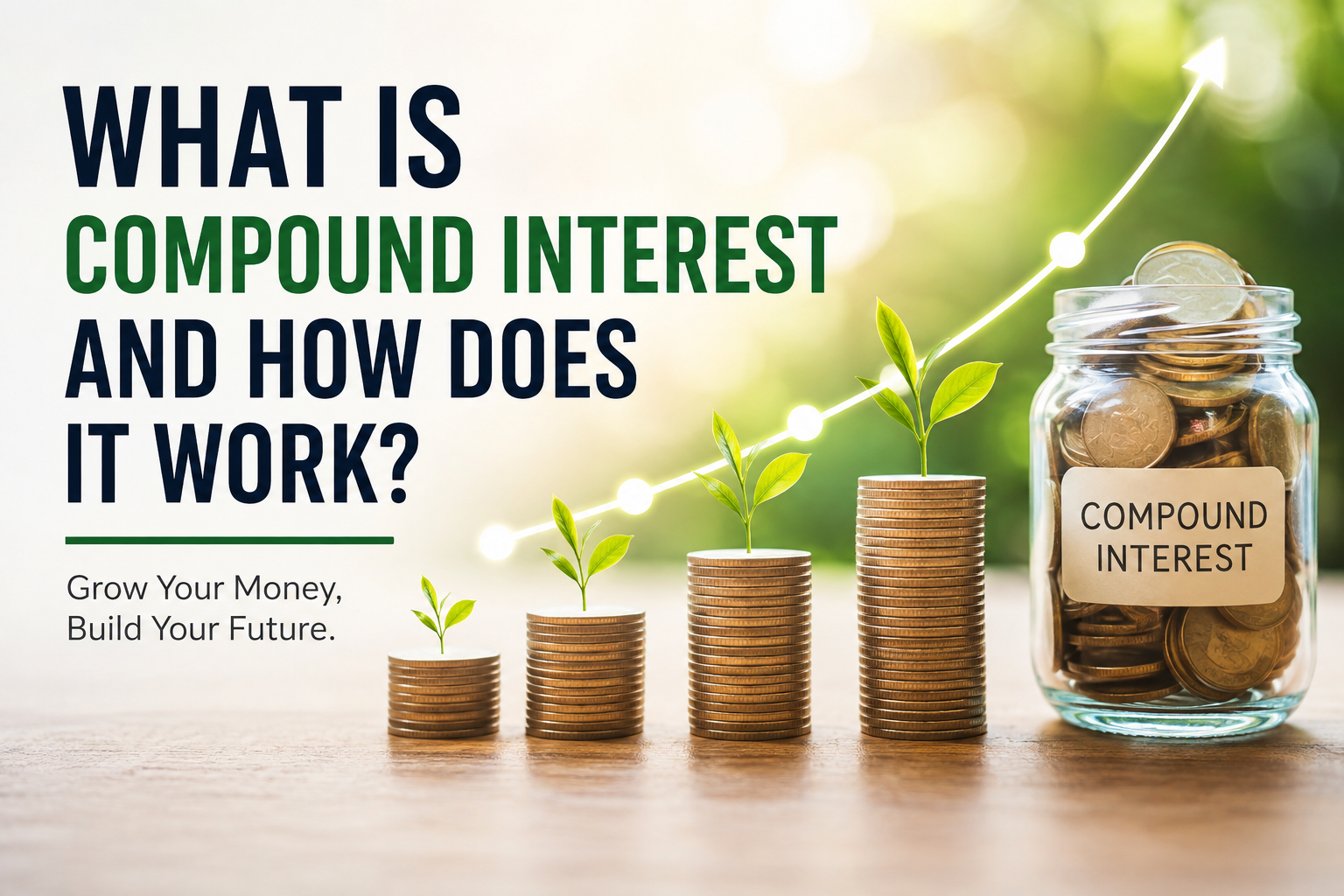
When I first started learning about money and investing, compound interest was one of those concepts that sounded complicated at first. After understanding it properly, I realized that it is actually a very simple idea. In my opinion, compound interest is one of the most important financial concepts that anyone should understand, especially if they want to save money, invest for the future, or build long term wealth.
The basic idea behind compound interest is that you earn interest not only on the money you originally put into an account, but also on the interest that has already been added to your money. This means your money can gradually start earning money on top of money. The longer you leave it alone, the more powerful the effect can become.
What Is Compound Interest?
Compound interest is interest calculated on both the original amount of money and the interest earned during previous periods.
For example, imagine I put $1,000 into a savings account that earns 5 percent interest per year. After one year, I would earn $50 in interest, giving me a total of $1,050.
With compound interest, the next year’s interest is calculated on $1,050 instead of the original $1,000. Five percent of $1,050 is $52.50. My balance would then become $1,102.50.
The important thing here is that I am no longer earning interest only on my original $1,000. I am also earning interest on the $50 that I earned during the first year.
This process continues year after year. That is what makes compound interest so interesting.
How Does Compound Interest Work?
To understand compound interest, I think it helps to look at a simple example.
Suppose I invest $2,000 and receive an annual interest rate of 6 percent. If the interest is compounded once a year, I would earn $120 during the first year.
My balance after the first year would be $2,120.
During the second year, the 6 percent interest would be calculated on $2,120 rather than $2,000. That means I would earn $127.20 in interest.
Now my balance would become $2,247.20.
In the third year, the interest would be calculated on $2,247.20. The interest earned would be slightly higher again.
This might not look like a huge difference in the beginning. However, when the same process continues for many years, the difference can become significant.
That is why I see compound interest as a long term financial tool rather than something that produces dramatic results overnight.
Simple Interest vs Compound Interest
It is also useful to understand the difference between simple interest and compound interest.
With simple interest, the interest is calculated only on the original amount of money. If I invest $1,000 at 5 percent simple interest, I earn $50 every year.
After ten years, I would have earned $500 in interest, assuming there are no other deposits or withdrawals.
Compound interest works differently. The interest I earn becomes part of my balance, and future interest is calculated on that larger balance.
This means the amount of interest I earn can increase over time.
The difference becomes much more noticeable when the money remains invested for many years.
In my opinion, this is one of the biggest reasons why people should start saving and investing as early as they reasonably can.
Why Time Matters So Much
One of the most powerful parts of compound interest is time.
When I think about compound interest, I do not only think about how much money I invest. I also think about how long I allow that money to grow.
Someone who starts investing at a young age may have decades for their money to compound. Another person who starts much later might invest more money but have less time for compounding to work.
This does not mean someone should avoid investing simply because they are starting late. It means that starting earlier can give your money more opportunities to grow.
For me, the biggest lesson is that consistency can sometimes be more important than trying to make a huge amount of money quickly.
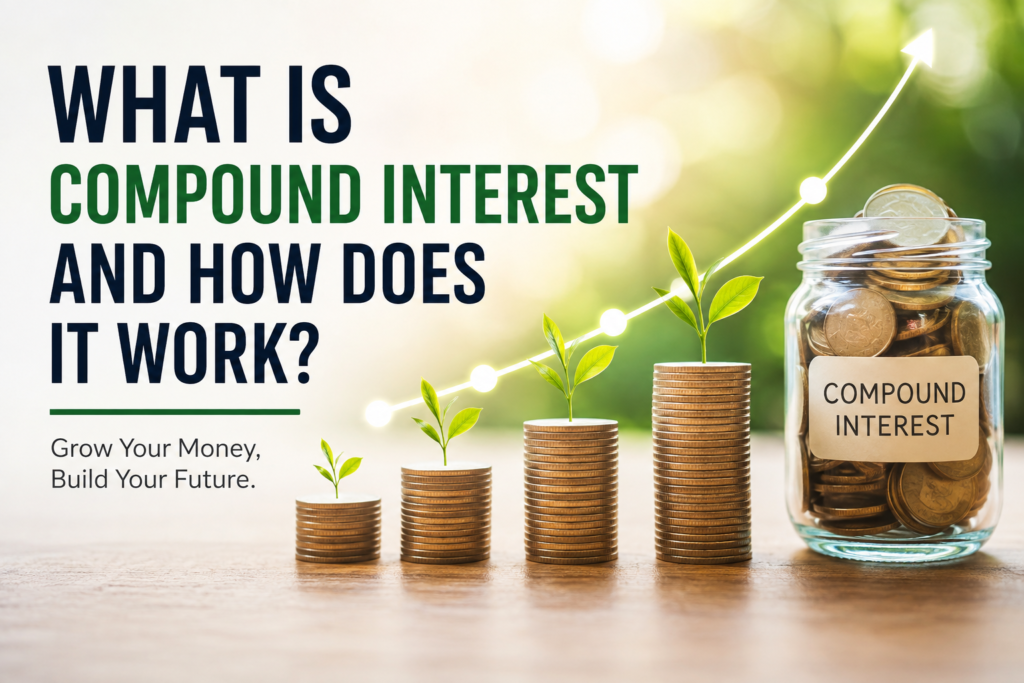
Compound Interest and Regular Contributions
Compound interest can become even more useful when I regularly add money to my savings or investments.
For example, instead of investing $1,000 once and leaving it alone, I could add another $100 every month.
Each contribution has the opportunity to earn returns over time. The earlier contributions have more time to grow, while newer contributions have less time.
This creates a snowball effect.
At the beginning, my account may appear to grow slowly. As the balance becomes larger, the amount of interest or investment growth can also become larger.
This is why I personally think regular saving is an important habit. I do not have to start with a huge amount of money. What matters is building the habit and giving the money enough time.
How Compounding Frequency Affects Growth
Compound interest can be calculated at different frequencies.
Some accounts compound annually. Others may compound monthly, quarterly, or daily.
When interest compounds more frequently, the interest is added to the balance more often. This can result in slightly greater growth over the same period, assuming the stated interest rate and other conditions are comparable.
For example, if interest is compounded monthly, interest earned during one month can become part of the balance used to calculate interest in a later month.
However, I would not focus only on how frequently interest compounds. I would also look carefully at the actual interest rate, fees, account terms, taxes, and other conditions.
A higher compounding frequency does not automatically mean an account is the best choice.
Compound Interest in Savings Accounts
Savings accounts are one of the easiest places to understand compound interest.
When I keep money in an interest bearing savings account, the bank may pay interest on my balance. If that interest is added to my account and I leave it there, future interest can be calculated on the larger balance.
The actual rate offered by banks can change depending on the account and economic conditions.
For this reason, I think it is important to read the terms of any savings account instead of assuming that every account works in exactly the same way.
It is also important to remember that inflation can reduce the purchasing power of money over time. Even if my account balance grows, the real value of that money depends on how prices change.
Compound Interest in Investing
Compound growth is also commonly discussed when people talk about investing.
When investments generate returns and those returns remain invested, future growth can occur on the larger investment value.
However, investing is different from earning a guaranteed interest rate in a savings account. Investment returns can rise and fall, and there is always some level of risk depending on the investment.
Stocks, bonds, mutual funds, exchange traded funds, and other investments can have different levels of risk and return.
So when I think about compounding in investing, I think about long term growth rather than guaranteed yearly interest.
The market can have good years and bad years. What matters is understanding the investment, managing risk, and having a time horizon that matches my goals.
The Rule of 72
There is also a simple way to estimate how long it might take money to double. It is called the Rule of 72.
I can divide 72 by an estimated annual rate of return to get a rough idea of the number of years needed for money to double.
For example, at an 8 percent annual return, 72 divided by 8 gives approximately 9 years.
This is only an estimate and should not be treated as an exact prediction. Actual investment results can vary, especially when returns change from year to year.
Still, I find the Rule of 72 useful because it makes the idea of long term compounding easier to understand.
Why Starting Small Can Still Matter
Sometimes people think they need thousands of dollars before they can start saving or investing. I do not think that is necessarily true.
Starting with a small amount can still help build good financial habits.
If I consistently save $20, $50, or $100 when I can afford it, I am not only putting money aside. I am also developing discipline.
Over time, regular contributions can become much more meaningful, especially when combined with compound growth.
The most important thing is not to invest money that I need for essential expenses. I should first understand my financial situation, maintain an appropriate emergency fund, and then consider longer term investments according to my goals and risk tolerance.
The Power of Patience
Compound interest rewards patience.
This is probably the biggest lesson I take from the concept.
People often want quick results when it comes to money. They may look for investments that can double their money rapidly or become wealthy within a few months. In my view, this mindset can lead to unnecessary risks.
Compound growth works differently. It is about giving money time to grow and allowing previous growth to contribute to future growth.
The results may look small at first, but patience can make the effect much more noticeable over longer periods.
Compound Interest and Debt
Compound interest is not always good news.
The same basic idea can work against me when I borrow money.
Credit cards and certain loans can charge interest on outstanding balances. If I do not pay the balance properly, interest can make the amount I owe grow.
This is why I believe understanding compound interest is useful not only for saving and investing but also for managing debt.
When borrowing money, I should pay attention to the interest rate, fees, repayment terms, and total cost of borrowing.
Final Thoughts
Compound interest is a simple financial concept with a powerful long term effect. It means earning returns on the original amount and on the returns that have already been added.
From my point of view, the most important factors are time, consistency, patience, and making sensible financial decisions.
I do not need to start with a huge amount of money to understand or benefit from the idea. Even small amounts can become more meaningful when they are saved regularly and given enough time to grow.
At the same time, I should remember that compound growth is not magic. Investment returns are not guaranteed, interest rates can change, inflation matters, and debt can make compounding work against me.
The main lesson I take from compound interest is simple. Money can grow faster when I give it time and allow the growth to remain invested. Starting early, saving consistently, and making informed decisions can give compounding the opportunity to do its work.
For anyone trying to improve their financial knowledge, I believe compound interest is one of the first concepts worth learning. Once I understand how it works, many other ideas about saving, investing, borrowing, and long term wealth become much easier to understand.