When I first started learning about credit cards, I thought interest was pretty simple. I assumed that if I borrowed money from my credit card, I would just pay a small extra amount when the bill arrived. Later, I realized that credit card interest can work differently depending on when I make a purchase, when I make a payment, and whether I pay my balance in full.
Understanding credit card interest is important because a balance that looks manageable today can become expensive over time. In my opinion, the biggest mistake people make is using a credit card without understanding how the interest is calculated. Once you understand the basic system, it becomes much easier to use a credit card responsibly.
What Is Credit Card Interest?
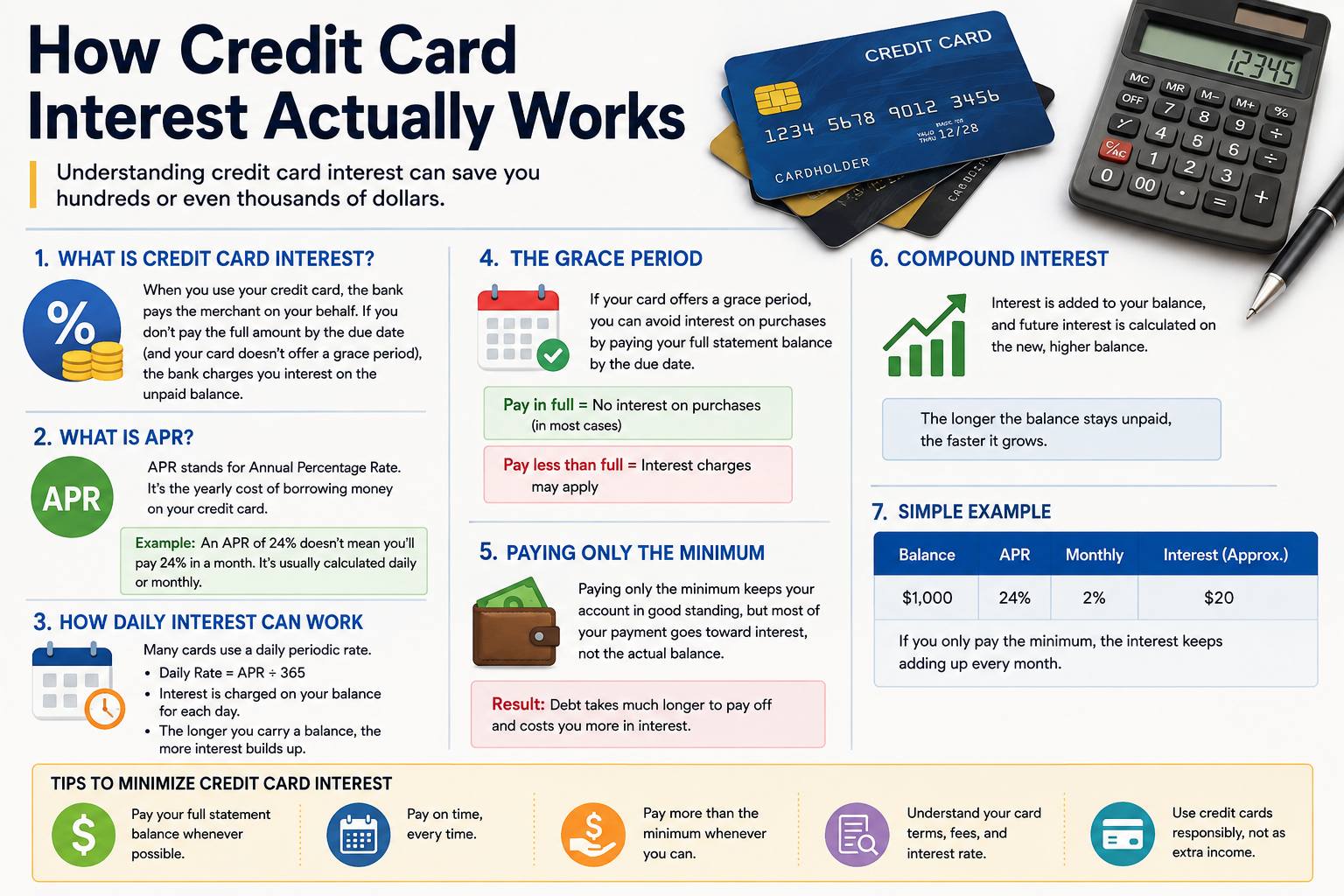
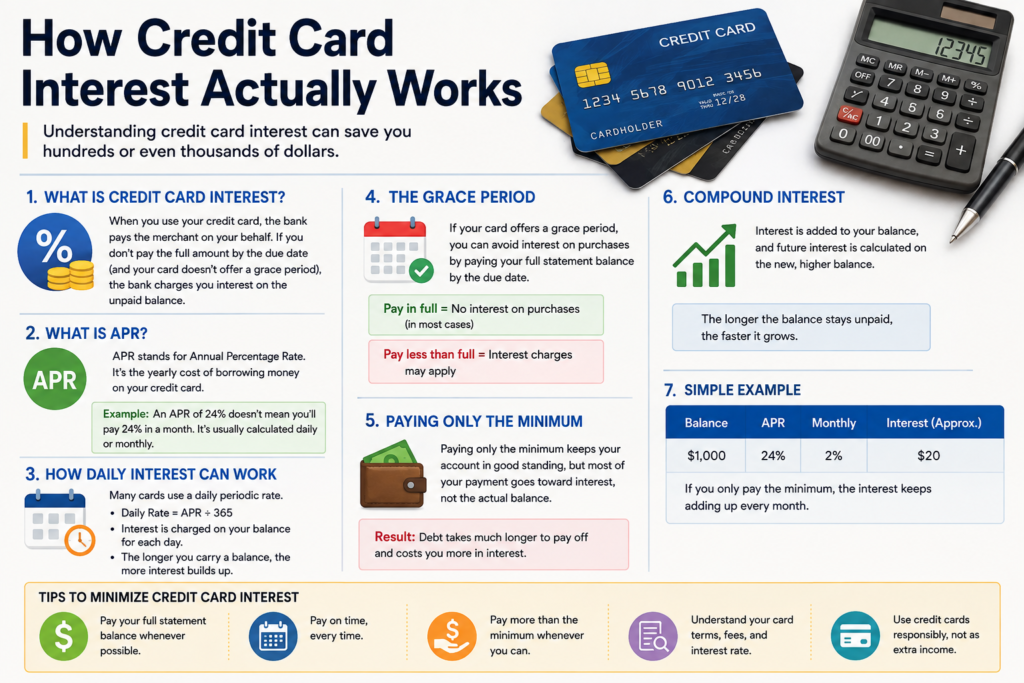
Credit card interest is basically the cost of borrowing money from your credit card company. When I use my credit card to buy something, the card company is paying the merchant on my behalf. I then have to repay that amount to the card company.
If I pay the full balance by the due date and my card offers a grace period, I may not have to pay interest on regular purchases. However, if I carry a balance from one billing period to the next, interest can be added to what I owe.
This is where credit cards become expensive. The interest does not usually feel like a large amount at first. But when the balance remains unpaid for several months, the cost can grow significantly.
What Is an APR?
One of the most important terms I look at when thinking about credit card interest is APR. APR stands for Annual Percentage Rate.
The APR tells me the approximate yearly interest rate associated with borrowing on the card. For example, if a credit card has an APR of 24 percent, that does not mean the company simply adds 24 percent to my balance once every year.
Credit card companies normally calculate interest using a periodic rate. The APR is converted into a daily or monthly rate depending on the card agreement.
For a simple example, if the APR is 24 percent, the monthly rate may be around 2 percent. The actual calculation can be more complicated because many credit cards use a daily periodic rate and calculate interest based on the balance during the billing cycle.
This is one reason I think looking only at the APR is not enough. I also need to understand how the card calculates interest.
How Daily Interest Can Work
Many credit cards calculate interest using a daily periodic rate. The card company may take the annual percentage rate and divide it by the number of days in the year.
For example, if the APR were 24 percent, the daily rate would be roughly 0.0658 percent. The company can then apply that rate to the balance for each day.
This means that the amount of interest can depend on how long I carry the balance.
If I owe a large amount and keep it unpaid for many days, more interest can build up. If I make a payment earlier, the balance may decrease sooner, which can reduce the amount of interest that accumulates.
This is why I do not look at credit card debt as just one fixed amount. Time matters too.
What Is a Grace Period?
A grace period is one of the most useful features of a credit card when it is used correctly.
For many credit cards, purchases may have a grace period that allows me to avoid interest if I pay the statement balance in full by the due date. The exact rules depend on the credit card agreement.
For example, imagine I use my credit card during the month and my statement balance is 1,000 dollars. If I pay the full 1,000 dollars by the due date, I may avoid interest on those purchases.
But if I only pay 100 dollars and leave 900 dollars unpaid, interest may begin to apply according to the terms of the card.
Personally, I see the grace period as one of the biggest advantages of a credit card. It allows me to use the card for convenience without paying interest, as long as I manage the balance properly.
What Happens When I Pay Only the Minimum?
This is where many people can get into trouble.
Credit card companies usually require a minimum payment every month. The minimum payment may be a small percentage of the total balance or a specific minimum amount.
At first, making the minimum payment can feel comfortable because it keeps the account current. However, paying only the minimum can cause the debt to remain for a long time.
For example, imagine I have a balance of 2,000 dollars and a high interest rate. If I only make small minimum payments, a significant portion of each payment may go toward interest instead of reducing the original balance.
I may feel like I am making progress, but the balance can decrease very slowly.
That is why I believe the minimum payment should be treated as the amount I must pay to avoid being late, not necessarily the amount I should aim to pay every month.
How Compound Interest Makes Debt Grow
Another important concept is compound interest. In simple terms, compound interest means that interest can be added to the balance, and future interest may then be calculated on the larger balance.
This can make credit card debt grow faster when payments are not enough to cover the balance.
For example, if I have an unpaid balance and interest is added, my new balance can become slightly higher. If I continue carrying the balance, future interest can be based on that higher amount.
Over several months, this effect can become noticeable.
This is one reason paying credit card debt early can make such a big difference. The sooner I reduce the balance, the less opportunity there is for interest to continue building.
Why Credit Card Interest Can Feel Confusing
I think credit card interest feels confusing because there are several numbers involved.
There is the credit limit, current balance, statement balance, minimum payment, APR, due date, and sometimes a daily periodic rate.
These numbers do different jobs.
The current balance tells me how much I owe at a particular moment. The statement balance is the amount shown on my latest statement. The minimum payment is the smallest amount I generally need to pay by the due date to keep the account from becoming late.
The APR tells me the annualized cost of borrowing.
Once I understood the difference between these numbers, credit cards became much easier for me to understand.
Purchases, Cash Advances, and Balance Transfers
Not every type of credit card transaction necessarily works in exactly the same way.
Regular purchases may qualify for a grace period depending on the card terms. Cash advances can have different rules and may begin charging interest immediately. Balance transfers can also have special terms, including promotional rates and transfer fees.
This is something I always think is worth checking before using a credit card for anything other than normal purchases.
A low promotional interest rate can look attractive, but I still need to read the conditions. Promotional periods eventually end, and fees may also apply.
Why Making Extra Payments Helps
One of the simplest ways I can reduce interest is by paying more than the minimum whenever possible.
If I have extra money available, putting it toward a high interest credit card balance can reduce the amount I owe. A smaller balance generally means less interest can accumulate.
I also prefer making payments earlier rather than waiting until the last possible day when I have the money available. Depending on how the card calculates interest, reducing the balance earlier can help reduce interest costs.
The important thing is consistency. Even an extra payment that seems small can make a difference over time.
A Simple Example
Let us say I have a credit card balance of 1,000 dollars and the card has a 24 percent APR.
A rough monthly interest rate could be around 2 percent. If I carried a 1,000 dollar balance for a month, the interest could be around 20 dollars before considering the exact daily calculation and any payments or other transactions.
Now imagine I continue carrying the balance for many months.
The cost does not simply disappear. Interest keeps accumulating according to the card terms. If I also continue making new purchases, the balance can become even harder to control.
This example shows me why a credit card should not be treated like free money. It is borrowed money, and borrowing for a long time can become expensive.
How I Would Use a Credit Card Responsibly
In my opinion, the best way to use a credit card is to treat it like a payment tool rather than extra income.
If I know I can afford a purchase with my normal income, using a credit card can be convenient. I can also benefit from rewards, purchase protections, or other features depending on the card.
But I would avoid buying something simply because my credit limit allows it.
A high credit limit does not mean I can afford to spend that much.
I also think checking the credit card statement every month is important. I want to know what I purchased, what balance I have, what payment is required, and whether any interest or fees were added.
My Biggest Lesson About Credit Card Interest
The biggest lesson I have learned is that credit card interest is not really about one large charge. It is about what happens when a balance stays unpaid over time.
A credit card can be useful when I pay my statement balance in full and understand the terms. The same card can become expensive when I repeatedly carry a balance and make only minimum payments.
That is why I believe understanding interest is more valuable than simply knowing the credit limit or rewards rate.
When I understand how APR, daily interest, grace periods, minimum payments, and compounding work, I can make much better financial decisions.
Final Thoughts
Credit card interest may seem complicated at first, but the basic idea is simple. When I borrow money and do not repay it within the terms that allow me to avoid interest, the credit card company charges me for carrying that debt.
The longer I carry the balance, the more the borrowing can cost me.
For me, the best approach is to spend carefully, pay the statement balance in full whenever possible, avoid relying on minimum payments, and check the card terms before using special features such as cash advances or balance transfers.
A credit card itself is not necessarily bad. The problem usually comes from misunderstanding how borrowed money works.
Once I understand how interest is calculated and how quickly it can add up, I can use a credit card as a financial tool instead of allowing it to become a financial burden.