When I first started learning about investing, one of the things that confused me most was the difference between stocks and bonds. Both are common investment options, both can help people build wealth, and both are available through many investment platforms. However, they work in very different ways.
In my opinion, understanding the difference between stocks and bonds is one of the first things a beginner should learn before putting money into the market. You do not need to become a financial expert overnight, but you should know what you are buying, how it can make money, and what risks you are taking.
In this article, I will explain stocks and bonds in simple language and share how I personally look at the differences between them.
What Are Stocks?
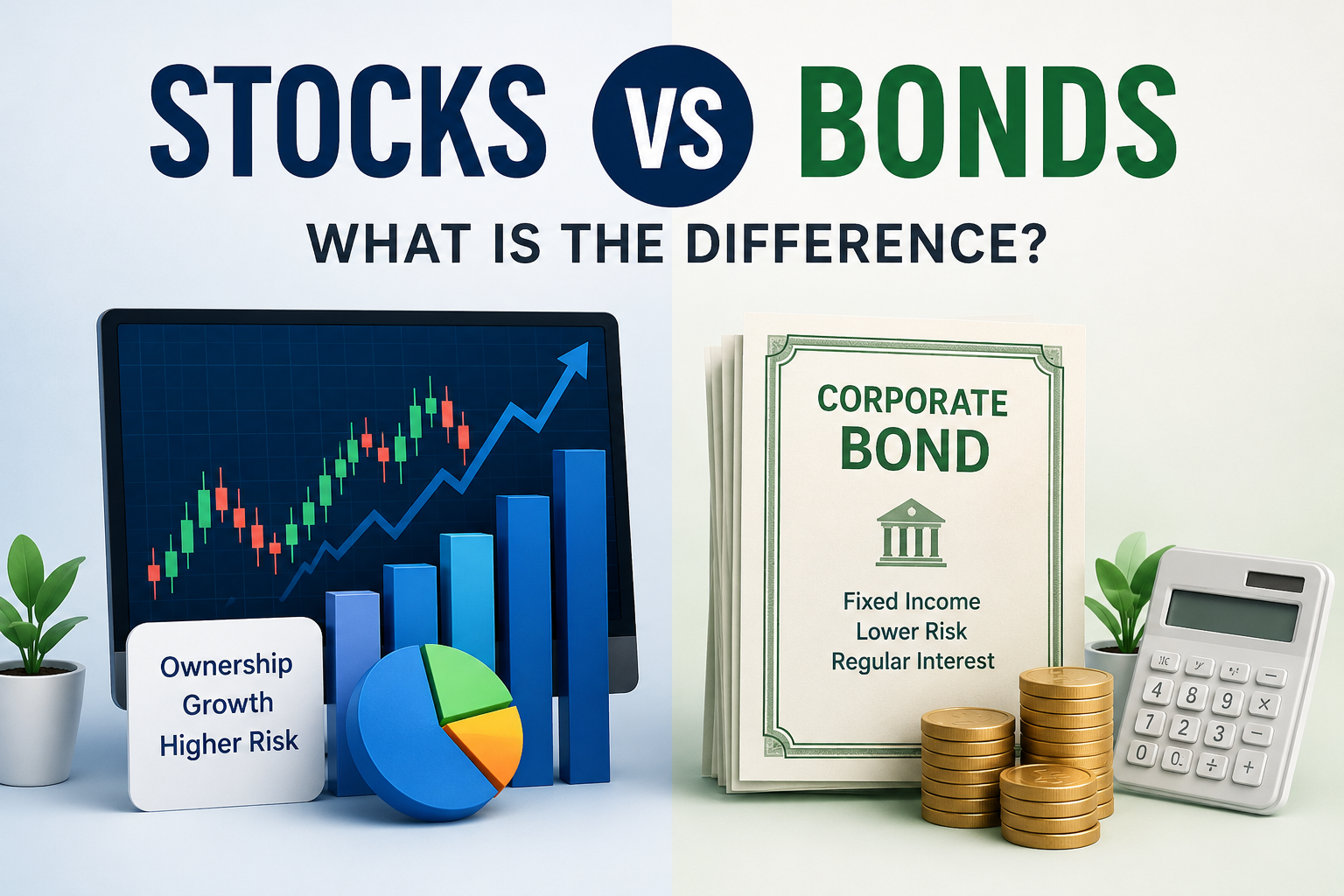
Stocks represent ownership in a company. When you buy a stock, you are essentially buying a small piece of that business. The amount of ownership you receive depends on how many shares you own compared with the total number of shares issued by the company.
For example, imagine a company has one million shares and you own one thousand shares. You own a very small portion of that company. Even though your ownership may be tiny, you are still technically a shareholder.
The main reason people buy stocks is to benefit from the growth of a company. If the company becomes more successful and investors believe it has a strong future, the stock price may increase. If you buy the stock at a lower price and later sell it at a higher price, you can make a profit.
Some companies also pay dividends to shareholders. A dividend is a portion of a company’s profits that may be distributed to investors.
From my point of view, stocks are attractive because they give investors the opportunity to participate in the growth of businesses. However, that opportunity also comes with risk because stock prices can move up and down significantly.
What Are Bonds?
Bonds work differently from stocks. When you buy a bond, you are generally lending money to a company, government, or other organization. In return, the borrower agrees to pay interest according to the terms of the bond and return the principal amount at maturity, assuming the issuer meets its obligations.
I think the easiest way to understand a bond is to imagine lending money to someone who promises to pay you interest and return your original money at a specific time.
For example, suppose you buy a bond with a face value of one thousand dollars. The bond may pay interest at a stated rate and eventually return your one thousand dollars when it reaches maturity.
Bonds are often considered more predictable than stocks, but that does not mean they are completely safe. Bond prices can change, and there is always some level of risk that the issuer may have trouble making payments.
The Main Difference Between Stocks and Bonds
The biggest difference is ownership versus lending.
When I buy a stock, I become a partial owner of the company. When I buy a bond, I become a lender to the bond issuer.
This difference affects how investors can make money and what kind of risks they face.
Stock investors generally hope that the value of their shares will increase. They may also receive dividends. Bond investors generally expect interest payments and the return of their principal according to the bond’s terms.
Another major difference is how these investments behave when markets become uncertain. Stocks can experience large price changes because investors constantly reassess the future of companies and the economy. Bonds can also fluctuate in price, especially when interest rates change, but many bonds have a defined maturity and payment structure.
Risk Level
Risk is one of the most important things I consider when comparing stocks and bonds.
Stocks can be risky because their prices may rise or fall quickly. A company can have disappointing earnings, lose customers, face stronger competition, or experience other problems that affect its stock price.
There is also the possibility of losing a significant portion of your investment if a company performs very badly.
Bonds generally have different types of risk. One important risk is credit risk, which means the possibility that the issuer cannot make its required payments. Another important risk is interest rate risk. When market interest rates rise, existing bonds can become less attractive, which can cause their market prices to fall.
So, I would not describe bonds as risk free. Instead, I would say that different bonds have different levels of risk, and investors should understand the issuer and terms before buying.
Potential Returns
Stocks generally have greater potential for long term growth, but investors must accept greater uncertainty.
If a company grows dramatically over many years, its stock could potentially increase substantially. This is one reason stocks are often used by investors who are focused on long term wealth building.
Bonds usually provide more predictable income through interest payments, depending on the type and terms of the bond. However, their growth potential is generally more limited compared with successful stocks.
Personally, I think this is an important tradeoff. Higher potential returns usually come with greater uncertainty. Lower potential returns may provide more stability and predictable income.
How Interest Rates Affect Bonds
Interest rates are especially important for bond investors.
Suppose you own an older bond that pays a certain interest rate. If newly issued bonds begin offering higher interest rates, your older bond may become less attractive to investors. As a result, its market price can fall.
The opposite can also happen. If market interest rates decline, an existing bond with a relatively higher interest payment may become more attractive, which can support its market value.
This relationship can seem complicated at first, but once I understood the basic idea, bonds became much easier to understand.
Dividends and Interest Payments
Stocks and bonds can both provide income, but the income works differently.
A company may pay dividends to its shareholders, but dividends are not guaranteed. A company can reduce, suspend, or eliminate its dividend depending on its financial situation and decisions.
Bond interest payments are generally based on the terms of the bond. If the issuer remains able to meet its obligations, investors typically receive the payments specified by the bond.
For someone who wants regular income, bonds can therefore be interesting. However, investors should still look carefully at the quality and terms of the bonds they are considering.
Which Is Better for Beginners?
I do not think there is one simple answer to this question.
Stocks may be suitable for people who have a long time horizon and are comfortable with market fluctuations. Someone investing for many years may be willing to accept short term price movements in exchange for the possibility of long term growth.
Bonds may appeal more to investors who want income, lower volatility in certain cases, or a way to balance the risk of a stock focused portfolio.
For many investors, the real answer may not be choosing between stocks and bonds at all. Instead, it may be finding an appropriate combination of both.
Why Diversification Matters
One of the biggest lessons I have learned about investing is that putting everything into one type of investment can create unnecessary risk.
Diversification means spreading investments across different assets instead of depending entirely on one investment.
For example, an investor could own stocks for long term growth while also holding bonds for income and portfolio balance. The exact combination depends on the person’s goals, financial situation, time horizon, and tolerance for risk.
Diversification cannot guarantee that you will avoid losses, but it can help reduce the impact of a poor performance from one particular investment or asset class.
Stocks vs Bonds During Market Changes
Stocks and bonds can react differently to economic conditions.
During periods of strong economic growth, stocks may benefit because companies can experience higher sales and profits. Investors may also become more optimistic about future growth.
During periods of economic uncertainty, investors may become more cautious. Depending on the circumstances, some investors may prefer investments that provide more predictable payments.
However, markets are complicated, and there is no rule that says stocks will always rise during good economic times or bonds will always perform well during difficult periods.
This is why I believe investors should avoid trying to predict every short term market movement.
What Should You Choose?
If I were explaining this to a complete beginner, I would say that the choice should start with your personal financial goals.
If your main goal is long term growth and you can handle significant price changes, stocks may deserve a larger role in your investment strategy.
If your priority is generating income or adding an investment that behaves differently from stocks, bonds may be worth considering.
If you are unsure, learning about diversified investment options can be a good starting point rather than immediately choosing individual stocks or bonds.
Most importantly, I would never invest money simply because someone online says an investment is guaranteed to make money. There is no investment that completely removes risk.
Final Thoughts
Stocks and bonds may look similar from a distance because both are financial investments, but they represent very different relationships.
Stocks give investors ownership in companies. Bonds generally represent loans made to companies or governments. Stocks usually offer greater growth potential but can experience larger price swings. Bonds can provide more predictable payments, although they still carry risks such as credit risk and interest rate risk.
For me, the most important thing is not deciding that stocks are better than bonds or that bonds are better than stocks. The better approach is understanding what each investment is designed to do.
Investing becomes much less confusing when you stop looking for a single perfect investment and start thinking about your goals, time horizon, risk tolerance, and overall portfolio.
If you are a beginner, take your time. Learn the basics, understand the risks, and never invest money you cannot afford to lose. Building financial knowledge is itself an investment, and in my opinion, it is one of the most valuable investments anyone can make.