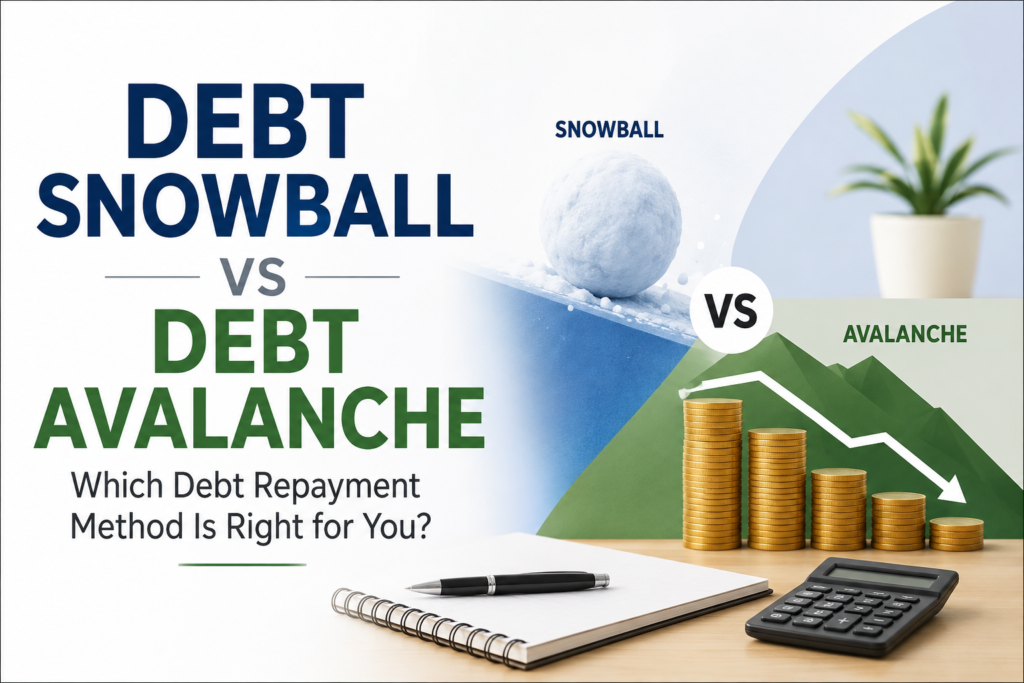
When I first started learning about debt repayment, I realized that paying off debt is not only about having enough money. It is also about having the right plan and sticking with it. Two of the most popular methods for paying off debt are the debt snowball and the debt avalanche.
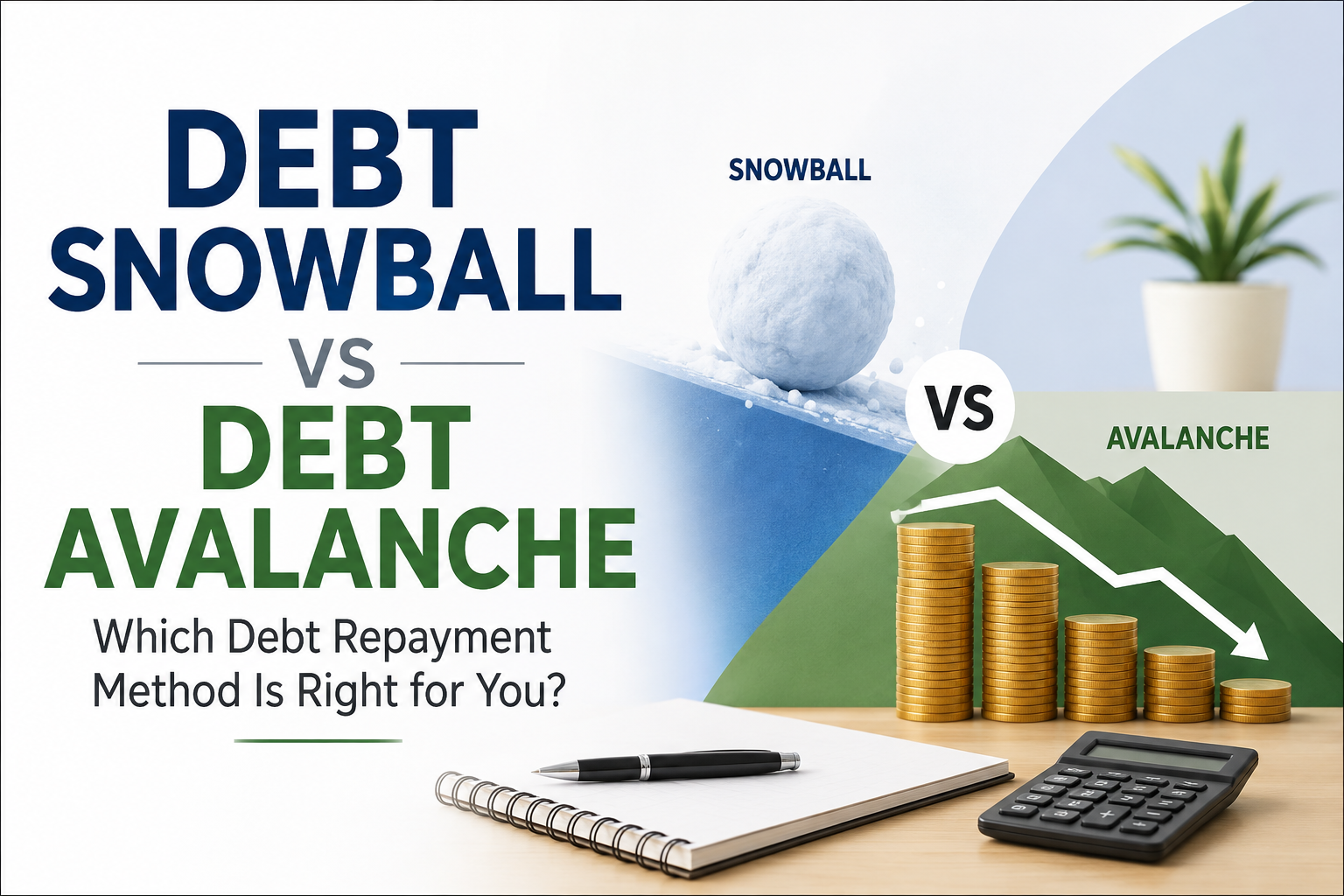
Both methods can help you become debt free, but they work in different ways. The debt snowball focuses on paying off your smallest balance first, while the debt avalanche focuses on paying off the debt with the highest interest rate first.
In my opinion, the best method depends on your personality, financial situation, and what keeps you motivated. Some people need quick wins to stay focused, while others prefer to save as much money as possible on interest.
In this article, I will explain both methods in simple words and compare them so you can decide which one may work better for you.
What Is the Debt Snowball Method?
The debt snowball method is a debt repayment strategy where you focus on your smallest debt first, regardless of its interest rate.
To use this method, you first make a list of all your debts from the smallest balance to the largest balance. You continue making the minimum payment on every debt, but you put any extra money toward the smallest debt.
Once the smallest debt is completely paid off, you take the money you were paying toward that debt and add it to the minimum payment of your next smallest debt.
You continue doing this until all your debts are gone.
The reason this method is called the debt snowball is because your payment becomes larger as you eliminate each debt. Just like a snowball getting bigger as it rolls downhill, your debt payments can become more powerful over time.
Example of the Debt Snowball
Imagine you have three debts.
Credit card one has a balance of $500.
Credit card two has a balance of $1,500.
A personal loan has a balance of $5,000.
With the snowball method, you would focus on the $500 debt first. You would make the minimum payments on the other two debts while putting as much extra money as possible toward the $500 balance.
Once the $500 debt is gone, you move to the $1,500 debt. You now use the money that was going toward the first debt to help pay off the second one faster.
After that, you attack the $5,000 loan.
The biggest advantage is that you can see progress relatively quickly.
What Is the Debt Avalanche Method?
The debt avalanche method takes a different approach. Instead of focusing on the smallest balance, you focus on the debt with the highest interest rate.
You still make the minimum payment on every debt, but you put your extra money toward the debt charging you the most interest.
Once that debt is paid off, you move to the debt with the next highest interest rate.
This method is designed to reduce the amount of interest you pay over time.
For people who are comfortable waiting longer for their first major debt payoff, the avalanche method can be a very efficient strategy.
Example of the Debt Avalanche
Let us use the same debts.
Credit card one has a balance of $500 with a 10 percent interest rate.
Credit card two has a balance of $1,500 with a 25 percent interest rate.
The personal loan has a balance of $5,000 with a 7 percent interest rate.
With the debt avalanche method, you would not automatically pay the $500 balance first.
Instead, you would focus on the $1,500 credit card because it has the highest interest rate.
You would make minimum payments on the other debts and put your extra money toward the $1,500 credit card.
After that debt is paid off, you move to the next highest interest rate.
This approach can potentially save you more money because you are attacking expensive debt first.
Debt Snowball vs Debt Avalanche
The biggest difference between these methods is what you prioritize.
The debt snowball prioritizes the smallest balance.
The debt avalanche prioritizes the highest interest rate.
The snowball method is more focused on motivation and psychological progress. The avalanche method is more focused on mathematical efficiency.
For example, if you have five debts, the snowball method might allow you to eliminate one or two small balances quickly. That can give you a feeling of accomplishment and make it easier to stay committed.
The avalanche method may take longer before you completely eliminate your first debt, especially if the debt with the highest interest rate has a large balance.
However, you may save more interest over the entire repayment period.
Which Method Saves More Money?
If your only goal is to minimize interest costs, the debt avalanche will usually be the better choice when applied consistently.
The reason is simple. High interest debt grows faster than low interest debt. By paying off the highest interest balance first, you reduce the amount of money that can accumulate through interest.
However, there is an important point that I think people sometimes overlook.
A mathematically better strategy is not always the best strategy for every person.
If someone starts with the avalanche method but becomes discouraged after several months because their largest debt is barely moving, they may stop following the plan. In that situation, the theoretically cheaper method may not actually save them money.
A simple plan that you can follow consistently can be more valuable than a perfect plan that you eventually abandon.
Which Method Is Better for Motivation?
For motivation, I personally think the debt snowball has a strong advantage.
Paying off a debt completely feels good. Even if the balance is small, seeing an account reach zero can give you confidence.
That feeling can encourage you to continue.
For someone who has several small debts, the snowball method can create visible progress early. This can make the entire process feel less overwhelming.
The avalanche method may require more patience. You could spend months attacking one high interest debt without completely paying it off.
Some people are perfectly comfortable with that. Others need visible results.
Knowing yourself is important here.
Advantages of the Debt Snowball
The debt snowball has several benefits.
First, it gives you quick wins. Paying off a small balance can happen relatively quickly.
Second, it can simplify your finances. Every time you eliminate a debt, you have one fewer payment to think about.
Third, it can improve motivation. Seeing debts disappear can make you feel that your hard work is actually producing results.
Finally, the method is extremely easy to understand. You simply arrange your debts from smallest balance to largest and start working through the list.
The main disadvantage is that you may pay more interest compared with the avalanche method.
Advantages of the Debt Avalanche
The biggest advantage of the debt avalanche is that it focuses on expensive debt first.
By attacking high interest balances, you can potentially reduce the total amount of interest you pay.
This can make the method financially efficient.
Another advantage is that it encourages you to look closely at interest rates. You become more aware of how much your debt is actually costing you.
The disadvantage is that progress may feel slower. If your highest interest debt also has a large balance, it may take a long time before you completely eliminate it.
That can be difficult for people who need frequent motivation.
How to Choose the Right Method
I would start by looking at your personality.
If you get motivated by small victories, the debt snowball may be a better fit.
If you are patient, disciplined, and want to minimize interest costs, the debt avalanche may make more sense.
I would also consider the size of your debts and the difference between your interest rates.
If one credit card has an extremely high interest rate compared with everything else, attacking it first can be financially attractive.
But if your debts have similar interest rates, the difference between the two methods may be less significant. In that situation, choosing the method that keeps you motivated could be more important.
Can You Combine Both Methods?
Yes, you can create your own approach.
Personal finance does not have to be completely rigid. You could start with the snowball method to eliminate a few small debts and then switch to the avalanche method.
You could also choose the highest interest debt while considering whether a small balance can be eliminated quickly.
For me, the most important thing is having a clear target. The biggest mistake is making random payments without knowing which debt you are trying to eliminate first.
Steps to Start Paying Off Debt
Start by writing down every debt you owe. Include the balance, minimum payment, and interest rate.
Next, calculate how much extra money you can put toward debt every month.
Then choose either the snowball or avalanche method.
Continue making the minimum payment on every account. Put your extra payment toward your selected target debt.
When that debt is completely paid off, move the money you were paying toward it to the next debt.
At the same time, try to avoid adding new unnecessary debt. Otherwise, you may feel like you are moving forward and backward at the same time.
My Final Thoughts
Debt can feel stressful, especially when you have several payments coming out of your income every month. But having a clear repayment strategy can make the situation feel much more manageable.
The debt snowball and debt avalanche are both useful methods. The snowball method focuses on small victories and motivation, while the avalanche method focuses on reducing expensive interest.
If you want the method that is generally more efficient mathematically, I would lean toward the debt avalanche.
If you know that quick progress keeps you motivated, I would seriously consider the debt snowball.
There is no need to feel bad about choosing one method over the other. The best debt repayment plan is the one you can actually follow month after month.
What matters most is starting, staying consistent, and avoiding the temptation to give up when progress feels slow.
For me, becoming debt free is not about finding a perfect strategy. It is about creating a realistic plan, following it with discipline, and gradually giving yourself more financial freedom. Whether you choose the snowball or the avalanche, every payment brings you one step closer to having less debt and more control over your money.