Credit card debt can become stressful very quickly. At first, it may seem like a small balance that you can easily manage. Then interest charges start adding up, and before you know it, a large part of your monthly income is going toward credit card payments.
In my opinion, the best way to deal with credit card debt is to stop looking at it as one huge problem. Instead, I prefer to break it into smaller steps. When you have a clear plan and follow it consistently, paying off debt becomes much more manageable.
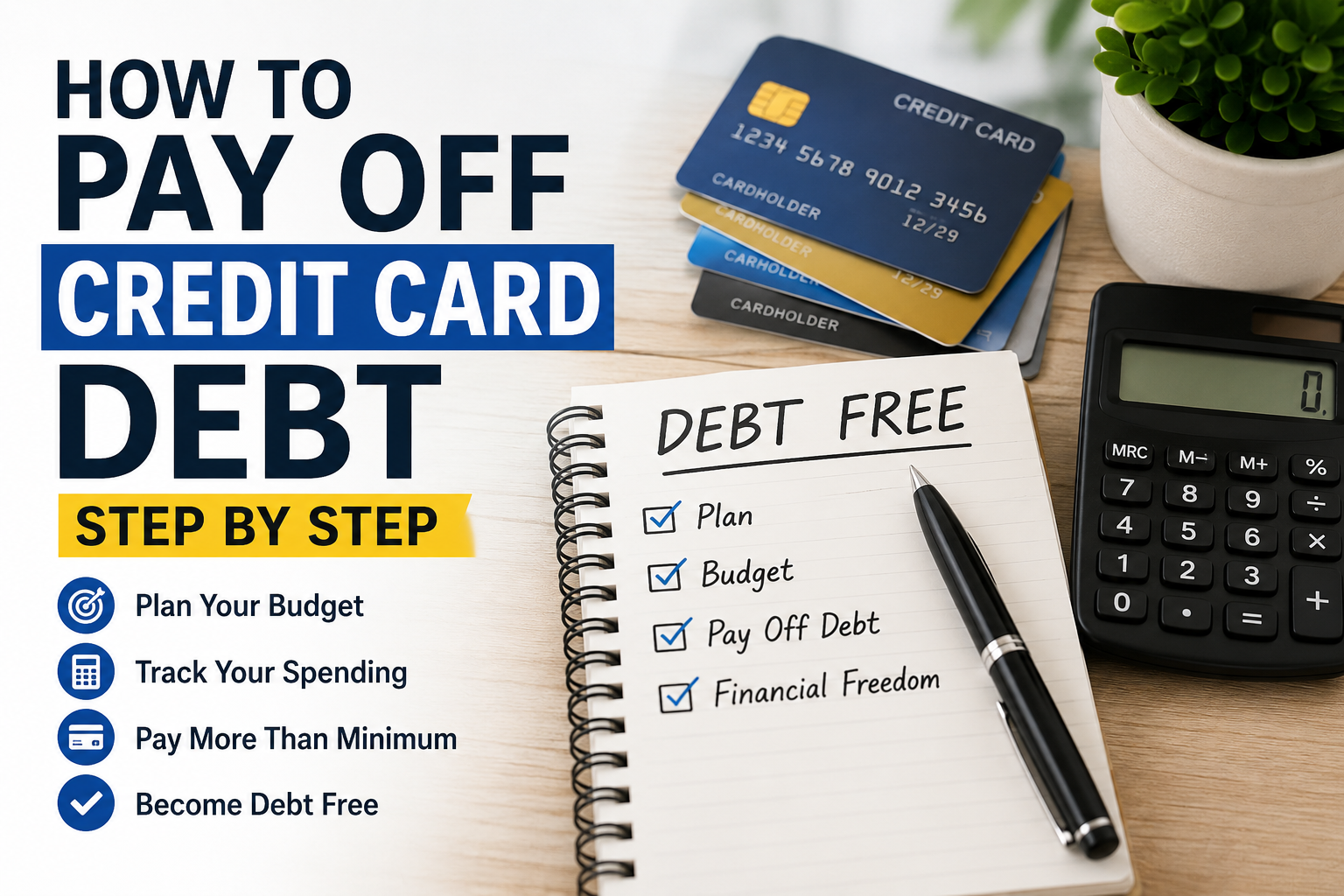
In this article, I will explain how to pay off credit card debt step by step. These are practical strategies that can help you understand your debt, control your spending, and gradually become debt free.
Step 1: Find Out Exactly How Much You Owe
The first thing I would do is stop guessing about the debt. Many people know that they have credit card debt, but they do not know the exact total amount.
Take some time to check every credit card account you have. Write down the current balance, interest rate, minimum payment, and payment due date.
For example, if you have three credit cards, you might have one balance of $1,500, another of $2,800, and another of $700. Seeing the complete picture can feel uncomfortable, but it is an important first step.
I believe that you cannot create a successful debt repayment plan until you know exactly what you are dealing with.
Step 2: Stop Adding New Credit Card Debt
Paying off your balance becomes much harder if you continue using your credit cards for unnecessary purchases.
This does not mean you have to solve everything overnight. Start by asking yourself whether you really need to use the card before making a purchase.
For some people, putting the physical cards away can help. Others may remove saved card information from shopping websites and mobile apps.
The goal is simple. You want the balance to move downward instead of constantly going up and down.
If you keep adding new purchases while trying to pay off old ones, it can feel like you are making payments without making real progress.
Step 3: Create a Simple Monthly Budget
A budget helps you understand where your money is going every month.
Write down your monthly income and your essential expenses. These may include rent, groceries, transportation, utilities, insurance, and other necessary costs.
After that, look at your nonessential spending. This could include eating at restaurants, entertainment, subscriptions, shopping, and other optional expenses.
I do not believe a debt repayment budget needs to make your life miserable. Instead, I would look for expenses that can be reduced without making daily life extremely difficult.
Even saving $100 or $200 each month can make a meaningful difference when that money is directed toward credit card debt.
Step 4: Always Pay at Least the Minimum
One of the most important rules is to make at least the minimum payment on every credit card by the due date.
Missing payments can lead to additional fees and may negatively affect your credit history. It can also make your debt more difficult to manage.
If possible, set up automatic payments for at least the minimum amount. This can reduce the chance of accidentally forgetting a payment.
However, paying only the minimum usually takes much longer to eliminate credit card debt. That is why the next step is so important.
Step 5: Choose a Debt Repayment Strategy
Once you are making minimum payments on all your cards, you can focus extra money on one card at a time.
Two popular approaches are the debt snowball method and the debt avalanche method.
With the debt snowball method, you focus on the card with the smallest balance first. You continue making minimum payments on the other cards while putting extra money toward the smallest balance.
Once that card is paid off, you move the money you were paying toward it to the next smallest balance.
The debt avalanche method works differently. You focus on the card with the highest interest rate first. This approach can potentially reduce the amount of interest you pay over time.
Personally, I think the best method is the one you can follow consistently. If seeing a small balance disappear motivates you, the snowball approach may feel rewarding. If saving interest is your biggest priority, the avalanche approach may make more sense.
Step 6: Pay More Than the Minimum Whenever Possible
If you only make minimum payments, a large portion of your payment may go toward interest rather than reducing the principal balance.
Try to find additional money that can go toward your target credit card.
This might come from reducing unnecessary expenses, selling items you no longer use, working extra hours, or earning money from a side activity.
You do not necessarily need a huge amount of extra money. Consistent additional payments can make a significant difference over time.
For example, if your budget allows you to pay an extra $100 every month, that is $1,200 more per year going toward your debt, before considering interest savings.
Step 7: Look for Ways to Reduce Your Interest Rate
Credit card interest can make debt repayment much more difficult.
Depending on your situation, you may be able to reduce the interest cost through options such as a lower interest credit card, a balance transfer offer, or a personal loan.
However, I would not choose any of these options without carefully checking the terms.
A balance transfer may come with fees or a limited promotional period. A personal loan may have its own interest rate and fees. The important thing is to compare the total cost rather than simply choosing the option with the lowest advertised rate.
Also, moving debt to another account does not solve the underlying problem if you continue spending beyond your budget.
Step 8: Use Unexpected Money Wisely
Whenever you receive unexpected money, consider putting some or all of it toward your credit card debt.
This could include a tax refund, work bonus, gift, or money from selling something.
Of course, you should also consider your other financial priorities. If you have no emergency savings at all, keeping some money available for unexpected expenses may be sensible.
The main idea is to avoid immediately spending every extra dollar. Unexpected money can be an opportunity to make a larger payment and reduce your debt faster.
Step 9: Build a Small Emergency Fund
One reason people fall back into credit card debt is that they have no money available when something unexpected happens.
A car repair, medical bill, home expense, or temporary loss of income can force someone to use a credit card again.
That is why I think it is useful to build at least a small emergency fund while working on debt.
You do not necessarily need to save a huge amount before making debt payments. Even a small emergency cushion can provide some protection against unexpected expenses.
Once your credit card debt is under control, you can work toward building a larger emergency fund.
Step 10: Track Your Progress
Debt repayment can take time, so it is important to see your progress.
I recommend checking your balances regularly and recording how much you have paid.
You could use a simple spreadsheet, notebook, budgeting app, or another method that works for you.
For example, if you start with $6,000 in credit card debt and eventually reduce it to $5,000, that is real progress. Sometimes people focus so much on what they still owe that they forget to recognize what they have already accomplished.
Tracking your progress can keep you motivated when the process feels slow.
Step 11: Avoid Lifestyle Inflation
As your financial situation improves, try not to immediately increase your spending.
For example, if you receive a raise at work, you may be tempted to upgrade your phone, buy a more expensive car, or increase your entertainment budget.
Instead, consider directing part of that additional income toward your debt.
This does not mean you can never enjoy your money. I believe enjoying life is important. The key is making sure that lifestyle improvements do not prevent you from reaching your financial goals.
Step 12: Celebrate Small Wins
Paying off debt is not always exciting. There may be months when you feel like you are making very little progress.
That is why I think small victories matter.
Celebrate when you pay off your first card. Celebrate when your total balance drops below an important number. Celebrate when you make several months of payments without adding new debt.
The celebration does not need to cost much money. The purpose is simply to recognize that your habits are changing.
What to Do After Paying Off Your Credit Cards
Once your credit card debt is gone, try not to return to the same habits that created the debt.
The money that was previously going toward credit card payments can now be used for other financial goals.
You could build an emergency fund, save for a major purchase, invest for the future, or pay down other forms of debt.
I think this is one of the most rewarding parts of becoming debt free. You are no longer using your income to constantly catch up with past spending. Instead, you can start using more of your money to build your future.
Final Thoughts
Paying off credit card debt is not something that usually happens overnight. It requires patience, discipline, and a realistic plan.
In my view, the most important thing is to start with a clear understanding of what you owe. Then create a budget, stop unnecessary new debt, make every required payment on time, and put extra money toward one balance at a time.
You do not have to be perfect. You just need to keep moving in the right direction.
Some months may be easier than others. Unexpected expenses may slow you down, and there may be times when you feel frustrated. That does not mean your plan has failed.
Every payment reduces the amount you owe. Every unnecessary purchase you avoid gives you more control. Every month you stay committed brings you closer to financial freedom.
The goal is not simply to reach a zero credit card balance. The bigger goal is to develop money habits that help you stay out of expensive debt in the future. Once you achieve that, you can begin focusing your money on saving, investing, and creating the financial life you actually want.