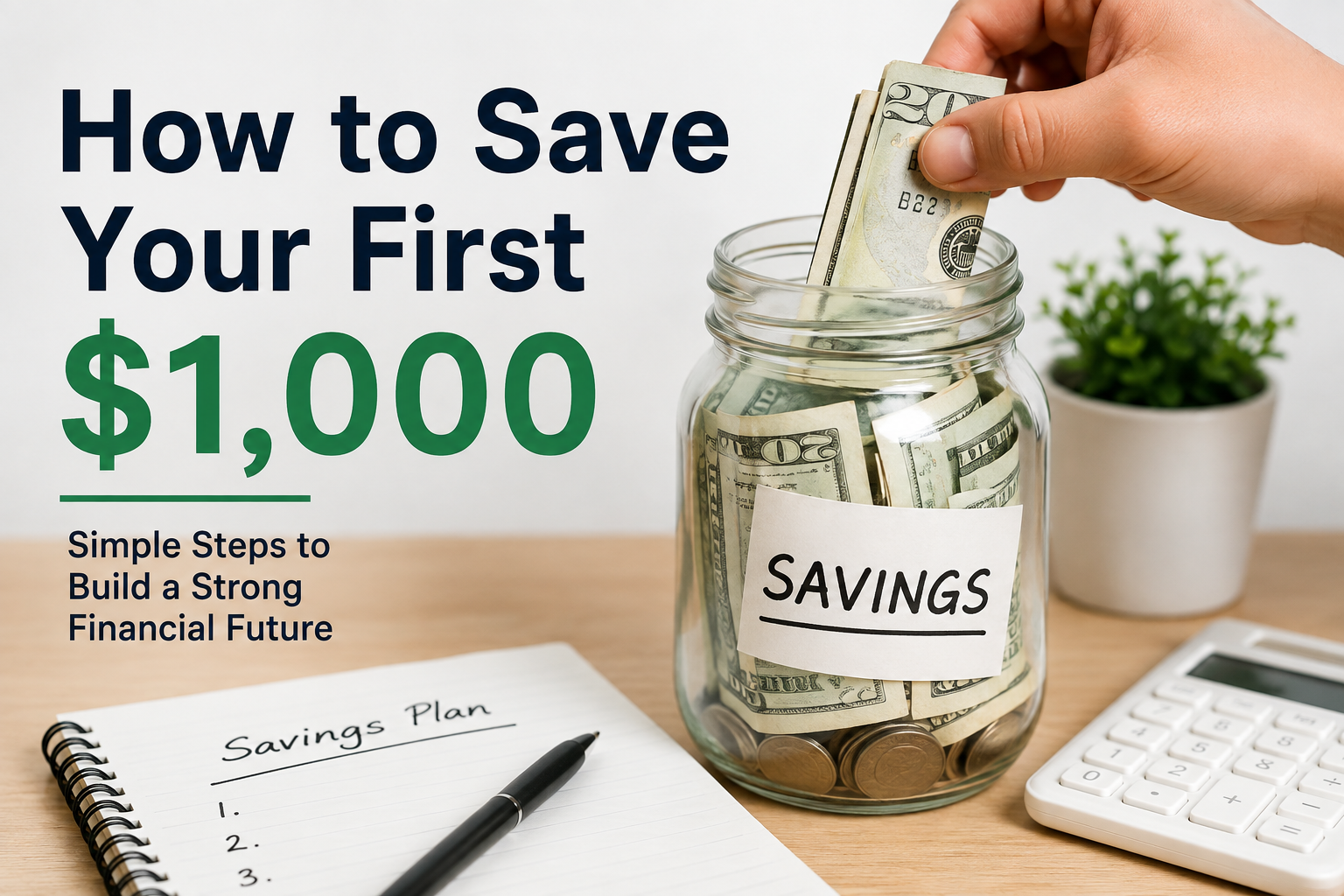
Saving your first $1,000 can feel difficult, especially when you have regular bills, daily expenses, and unexpected costs coming up all the time. I remember that saving a large amount of money can seem impossible when you are starting from zero. However, I have learned that the first $1,000 is not really about earning a huge amount of money. It is more about changing the way you look at your money and making small decisions consistently.
For me, the biggest mistake people make is thinking they need to save hundreds of dollars every week. That can make the goal feel stressful before you even begin. Instead, I prefer to break the goal into smaller and more realistic amounts. When I look at saving $1,000 as saving a little every day or every week, the goal becomes much easier to understand.
In this article, I will share the methods I would personally use to save my first $1,000 and build better money habits at the same time.
Start With a Clear $1,000 Goal
The first thing I would do is make the goal specific. Instead of simply saying that I want to save money, I would write down, “I want to save my first $1,000.”
A clear number gives you something to work toward. It also makes it easier to track your progress. Every time you put money aside, you can see yourself getting closer to the goal.
I would also choose a realistic deadline. For example, saving $1,000 in five months means putting away about $200 per month. If that feels difficult, you could give yourself eight months or a year.
The important thing is not how quickly you reach $1,000. The important thing is developing a habit that you can actually maintain.
Find Out Where Your Money Is Going
Before trying to save more, I think it is important to understand where your money is currently going. Many people believe they do not earn enough to save, but sometimes the problem is that small expenses are adding up without being noticed.
For one month, I would keep track of everything I spend. This includes groceries, transportation, subscriptions, snacks, online shopping, restaurant meals, and even small purchases.
You do not need a complicated system. A simple notes app or spreadsheet can work perfectly.
Once you see your spending clearly, you may notice some areas where you can make changes. Maybe you are spending too much on food delivery or buying things online that you do not really need.
I believe tracking spending is one of the most useful steps because you cannot improve something you are not paying attention to.
Set a Weekly Savings Target
Instead of focusing on the entire $1,000, I would create smaller weekly targets.
For example, saving $25 every week would give you about $1,300 in one year. Saving $50 every week would give you about $2,600 in one year.
You can choose an amount based on your income and expenses.
If you cannot save $50 every week, that is completely fine. Start with $10 or $20. The goal is to create consistency.
I personally think saving a smaller amount regularly is better than trying to save a large amount once and then giving up because it becomes too difficult.
Cut One or Two Unnecessary Expenses
You do not need to completely change your lifestyle to save your first $1,000. I would start by looking for one or two expenses that I could reduce.
For example, you might decide to eat at home more often instead of ordering food several times a week. You could make coffee at home instead of buying it every morning. You could also cancel subscriptions that you rarely use.
The idea is not to remove everything you enjoy. I believe that extreme budgeting can become frustrating and difficult to maintain.
Instead, focus on expenses that do not provide much value to you. If you are paying for a service you rarely use, canceling it can be an easy way to create extra savings.
Try a No Spend Challenge
Another method I would use is a short no spend challenge.
This does not mean that you stop spending money completely. You still need to pay for important things such as housing, food, transportation, and bills.
Instead, I would avoid unnecessary purchases for seven days or even thirty days.
During this period, I would avoid impulse shopping, unnecessary restaurant visits, entertainment purchases, and random online orders.
A no spend challenge can show you how often you buy things simply because you feel like buying them. It can also help you discover that you can live comfortably without many of those purchases.
Even if you save only $50 or $100 during the challenge, that money moves you closer to your $1,000 goal.
Save Your Extra Income
If you receive extra money, I would try not to spend all of it immediately.
Extra income could come from overtime, freelance work, a bonus, selling unused items, or receiving a cash gift.
For example, if I made an extra $200 from selling things I no longer needed, I could put that money directly into my savings account.
Selling unused items can be especially useful when you are trying to save your first $1,000. Look around your home for clothes, electronics, furniture, books, or other things you no longer use.
You might be surprised by how much money you can make from things that are simply sitting around.
Consider Making Extra Money
Sometimes cutting expenses is not enough. If your income is already tight, I think increasing your income can make the process much easier.
There are many ways to earn extra money depending on your skills and available time.
You could take freelance jobs, tutor students, do delivery work, provide online services, sell products, or help people with tasks they do not have time to do themselves.
Even an extra $50 per week can make a meaningful difference.
I would treat this extra income differently from my regular income. Instead of allowing it to disappear into everyday spending, I would send most or all of it directly to my savings goal.
Automate Your Savings
One of the easiest ways to save money is to make the process automatic.
If possible, I would set up an automatic transfer from my checking account to my savings account every time I receive my income.
For example, if you get paid every two weeks, you could automatically move $50 into savings after each paycheck.
The benefit is that you do not have to make the decision every time. The money moves automatically before you have an opportunity to spend it.
I believe this can be much easier than trying to save whatever money is left at the end of the month.
Keep Your Savings Separate
I would also keep my savings in a separate account from the account I use for everyday spending.
When savings and spending money are sitting together, it can be tempting to use the savings for unnecessary purchases.
A separate savings account creates a small mental barrier. When you see the money growing, you may also become more motivated to protect it.
I would name the account something meaningful, such as “My First $1,000.” Seeing that name can remind you why you are saving.
Avoid Impulse Purchases
Impulse spending can make saving much harder.
One simple rule I like is to wait before buying something that is not necessary. If I see something I want, I can wait 24 hours before making the purchase.
For more expensive items, I might wait several days.
Often, the desire to buy something disappears after a little time. This gives you an opportunity to decide whether you actually need the item or simply wanted it in that moment.
Every purchase you avoid does not mean you are missing out. Sometimes it simply means you are choosing a bigger goal over a temporary desire.
Track Your Progress
I would make saving fun by tracking my progress.
You could create a simple chart with ten sections of $100 each. Every time you save another $100, mark one section as complete.
Watching the progress can be surprisingly motivating.
For example, reaching $100 feels good. Reaching $300 feels even better. When you reach $700, you know that you are getting close.
The goal starts to feel real because you can see the progress instead of simply thinking about it.
Do Not Touch the Money Unless It Is Important
Once you start building your savings, you may be tempted to use it.
I would try to treat the $1,000 as money with a specific purpose. If it is being saved as an emergency fund, I would only use it for genuine emergencies.
This is important because constantly taking money out and putting it back can make saving feel like you are going nowhere.
Of course, if something genuinely important happens, using your savings is exactly what savings are for. There is no reason to feel guilty about using money for a real emergency.
What I Would Do After Reaching $1,000
Reaching your first $1,000 should not be the end of your savings journey.
For me, I would treat it as the beginning.
Once I reached $1,000, I would continue the same habits and slowly increase my savings target. The next goal could be $2,000, then $5,000, and eventually enough money to cover several months of essential expenses.
The first $1,000 is valuable because it teaches you something more important than saving money. It teaches you that you can control your spending, create goals, and build financial discipline.
You do not have to become perfect with money. You just need to become more intentional with it.
Final Thoughts
Saving your first $1,000 may look difficult at the beginning, but I believe it becomes much easier when you stop looking at the entire amount and start focusing on small steps.
Track your spending, create a weekly savings target, reduce unnecessary expenses, earn extra money when possible, automate your savings, and avoid impulse purchases.
Most importantly, do not compare your progress with someone else’s financial situation. If you can save $10 this week, that is still progress. If you can save $100, that is progress too.
The most important thing is to start.
Your first $1,000 can give you more than money in a savings account. It can give you confidence, financial discipline, and a sense of security. Once you prove to yourself that you can save $1,000, bigger financial goals can start to feel much more achievable.
In my opinion, the hardest part is usually getting started. Once the habit becomes part of your routine, saving money can become much more natural. Start with what you can afford today, stay consistent, and let those small amounts slowly turn into something meaningful.