When I first started paying attention to my money, I found budgeting much harder than I expected. I knew I should save money, control my spending, and avoid unnecessary expenses, but I did not really know how much I should spend on different things. There were so many budgeting methods available that choosing one felt confusing.
Then I came across the 50/30/20 budget rule.
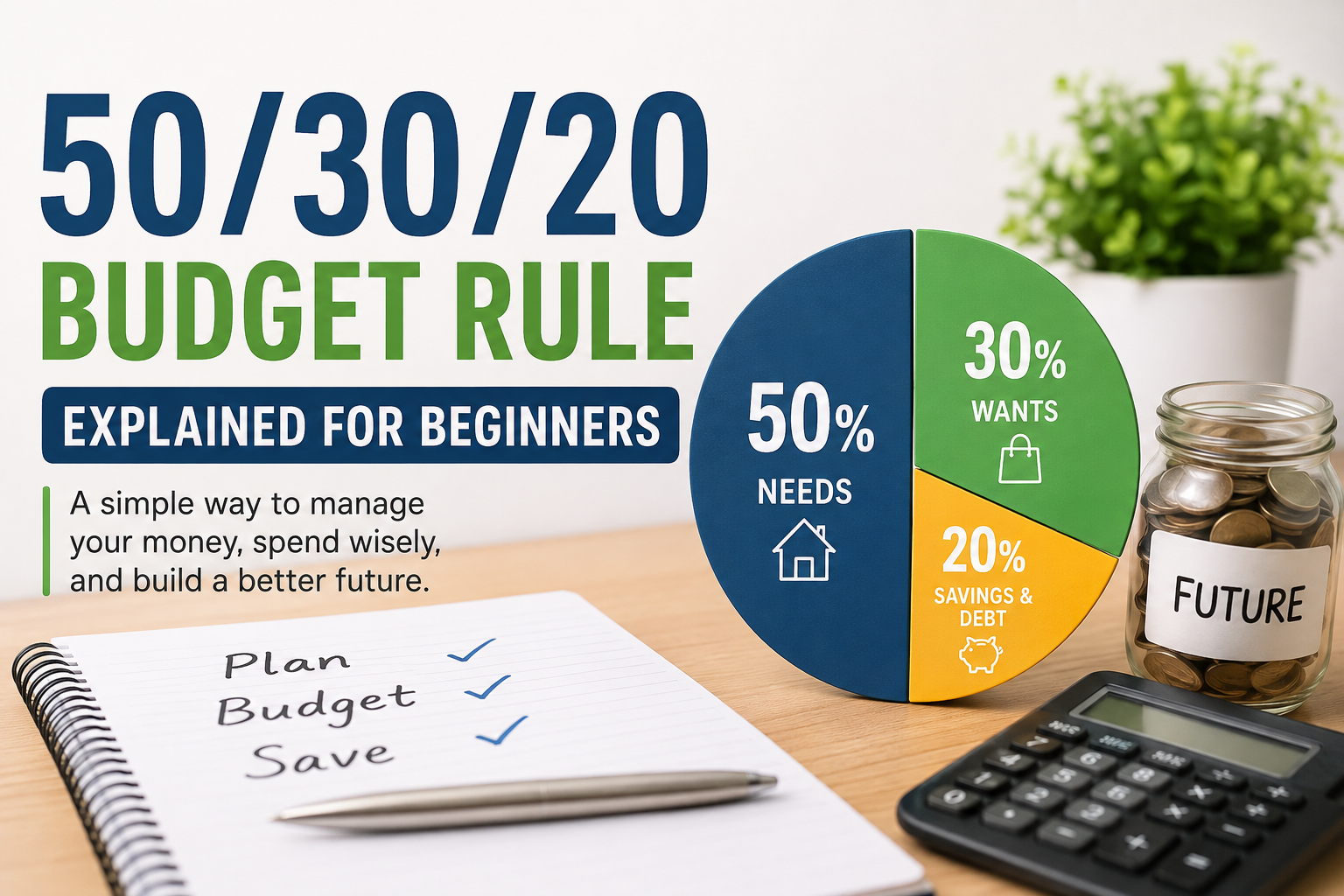
What I like about this method is that it is simple enough for beginners. Instead of creating a complicated budget with dozens of categories, the 50/30/20 rule divides your after tax income into three main areas. Fifty percent goes toward needs, thirty percent goes toward wants, and twenty percent goes toward savings and debt payments.
In my opinion, this is a useful starting point for anyone who wants to manage money without making budgeting feel like a full time job.
What Is the 50/30/20 Budget Rule?
The 50/30/20 budget rule is a simple budgeting method that divides your monthly after tax income into three sections.
Fifty percent is for needs.
Thirty percent is for wants.
Twenty percent is for savings and debt payments.
For example, if I take home $3,000 per month after taxes, I would divide my money like this.
$1,500 for needs
$900 for wants
$600 for savings and debt payments
The idea is not that these numbers must be perfect every single month. Life does not always work that way. Some months I may have a higher electricity bill, a medical expense, or another unexpected cost. I see the 50/30/20 rule more as a guideline that helps me understand where my money should generally go.
Understanding the 50 Percent for Needs
The first part of the rule is the fifty percent category. This money is meant for things I genuinely need to live and maintain my basic lifestyle.
Needs usually include expenses such as housing, groceries, utilities, transportation, insurance, minimum debt payments, and basic healthcare costs.
For me, an important question when creating this category is whether an expense is actually necessary or simply something I enjoy having.
For example, buying basic groceries is a need. Ordering restaurant food several times a week is usually a want. Paying for basic transportation to work can be a need, while upgrading to a more expensive car simply because I like it may be a want.
This distinction can sometimes be difficult.
Housing is often one of the biggest needs in a budget. If rent or a mortgage takes up a very large part of my income, following the fifty percent target can become difficult. That does not mean the entire budgeting method has failed. It simply tells me that my fixed expenses may need attention.
I would rather use the rule as a way to identify problems than feel guilty because my numbers are not exactly fifty percent.
Understanding the 30 Percent for Wants
The next thirty percent is for wants.
This is the category that I think makes the 50/30/20 rule more realistic than extremely strict budgeting methods. I do not believe that managing money means removing every enjoyable thing from life.
Wants can include entertainment, eating at restaurants, hobbies, shopping, vacations, streaming subscriptions, gaming, expensive coffee, and other lifestyle choices.
For example, if I enjoy watching movies online and pay for a streaming service, that is probably a want. If I enjoy going out for dinner with friends, that is also a want.
The important thing is to understand that wants are optional expenses. I can live without them, even if they make my life more enjoyable.
This category also gives me some freedom. Instead of wondering whether I am allowed to spend money on something enjoyable, I can look at my overall wants budget and decide whether the expense fits inside it.
I think this is especially helpful for beginners because an overly strict budget can become frustrating very quickly. If I completely remove entertainment and personal spending from my budget, I may follow the plan for a short time and then give up.
Understanding the 20 Percent for Savings and Debt
The final twenty percent is for savings and debt payments.
This is the part of the rule that can have a major impact on my financial future.
Savings can include building an emergency fund, saving for a large purchase, investing for retirement, or working toward other financial goals.
Debt payments can also be included, especially payments above the required minimum. The exact way I divide this twenty percent depends on my financial situation.
If I have high interest debt, paying it down may be one of my biggest priorities. If I have little or no debt, I may focus more heavily on building savings and investing.
One goal I would personally prioritize is creating an emergency fund. Having money set aside for unexpected expenses can make financial emergencies much less stressful.
For example, if my car needs an unexpected repair or I suddenly have a large household expense, I do not necessarily have to depend on a credit card if I already have emergency savings.
How to Calculate the 50/30/20 Rule
Calculating the rule is actually quite simple.
First, I need to know my monthly after tax income. This is the money that actually reaches my bank account after taxes and other required deductions.
Then I multiply that amount by each percentage.
For example, if my monthly after tax income is $2,500, I can calculate my targets like this.
Fifty percent of $2,500 is $1,250.
Thirty percent of $2,500 is $750.
Twenty percent of $2,500 is $500.
That gives me a simple monthly framework.
I would then compare these targets with my actual spending.
If my needs are $1,400 instead of $1,250, I know that my needs are taking up a larger portion of my income. I can then look at those expenses and decide whether there is anything I can reduce.
What If My Needs Are More Than 50 Percent?
This is one of the most common questions beginners have.
What happens if my rent, groceries, transportation, and other essential expenses already use more than half of my income?
In my opinion, I should not panic.
The 50/30/20 rule is not a law. It is a guideline.
Housing costs can be very different depending on where someone lives. Family responsibilities, income levels, transportation needs, and other circumstances can also make the percentages difficult to follow.
If my needs take up sixty percent of my income, I can still use the other parts of the system. Maybe I reduce wants to twenty percent and try to keep ten or fifteen percent for savings.
The most important thing is to create a budget that reflects reality.
I would rather save ten percent consistently than create an unrealistic plan that tells me I must save twenty percent and then fail every month.
Can I Change the Percentages?
Yes. I think one of the biggest advantages of the 50/30/20 rule is that I can adjust it.
For someone with a lower income and high essential expenses, the percentages may need to be different.
For someone with a high income and low living expenses, saving more than twenty percent may be possible.
For example, someone might use a 60/20/20 approach, where sixty percent goes to needs, twenty percent to wants, and twenty percent to savings.
Another person might be comfortable with 50 percent needs, 20 percent wants, and 30 percent savings.
There is no single budget that works perfectly for everyone.
Common Mistakes Beginners Make
One mistake I see people make with budgeting is trying to make every number perfect.
Budgeting is not about perfection. It is about awareness.
Another mistake is confusing wants with needs. A bigger home, expensive phone, premium subscription, and frequent restaurant meals may feel necessary because they have become part of my lifestyle. But that does not automatically make them needs.
Another common mistake is forgetting irregular expenses.
Some expenses do not happen every month. Annual insurance payments, gifts, school expenses, car maintenance, and holidays can still affect my finances.
I think it is useful to create a separate savings category for these expenses so they do not become surprises later.
How I Would Use the 50/30/20 Rule
If I were starting a budget from scratch, I would first calculate my actual monthly income.
Then I would list all my regular expenses.
After that, I would separate them into needs, wants, and savings or debt payments.
I would compare my current spending with the 50/30/20 targets.
If my spending was far from the guideline, I would not try to change everything in one day. I would start with one or two categories where I could realistically make improvements.
For example, if I discovered that I was spending too much on food delivery, I could reduce those orders. If subscriptions were taking more money than I realized, I could cancel the services I rarely use.
Small changes can make a meaningful difference when I continue them for many months.
Why I Like This Budgeting Method
The main reason I like the 50/30/20 rule is that it gives me structure without making money management unnecessarily complicated.
I know that some of my money should cover basic needs. I know that some money can be used for enjoyment. I also know that a portion should be directed toward my future.
That balance is important to me.
I do not want a financial plan that only focuses on saving money while ignoring the present. At the same time, I do not want to spend everything today and leave nothing for future goals.
The 50/30/20 rule creates a middle ground.
Final Thoughts
The 50/30/20 budget rule is a simple way for beginners to understand where their money is going. The basic idea is straightforward. Around fifty percent of after tax income goes toward needs, thirty percent goes toward wants, and twenty percent goes toward savings and debt payments.
However, I do not think anyone should treat these percentages as strict rules.
Personal finances are different for everyone. My income, housing costs, family responsibilities, debt, and goals may be completely different from someone else’s.
For me, the real value of this method is not hitting exactly fifty, thirty, and twenty every month. The real value is having a clear framework that helps me make better decisions with my money.
Once I understand where my money is going, I can make changes with more confidence. I can spend without unnecessary guilt, save with a clear purpose, and work toward a more stable financial future.
That is what makes the 50/30/20 budget rule a useful starting point for beginners.